
Among different types, models, and varieties available, choosing a dental milling machine for dental labs seems a confusing job sometimes. Just as the same size does not fit all, the same type of dental CAD/CAM milling machine cannot fit every dental care business.
A dental laboratory usually requires high precision, lightning-fast production speed, and low-maintenance equipment to run the processes smoothly and efficiently. Eventually, dental labs require advanced dental milling machines.
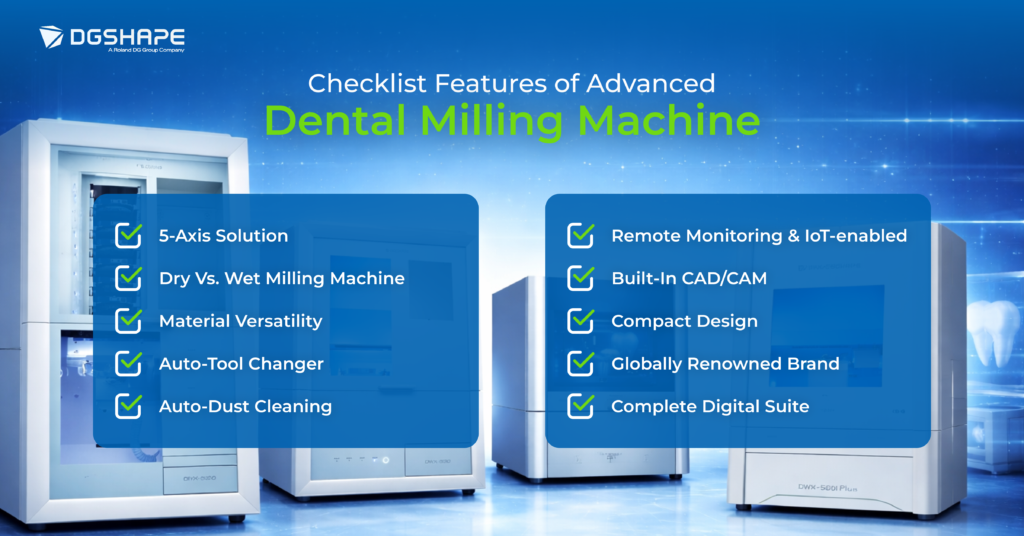
But what features make a dental mill ‘advanced’? Let’s discover in this blog and choose the best one for your dental lab:
#1 An Advanced Dental CAD/CAM Milling Machine is 5-Axis
In our previous blog titled “What is a dental milling machine?”, we explained various types of dental CAD/CAM milling machines. On the basis of machine movements and rotations, a dental mill can be classified into 4-axis and 5-axis machines.
While the 4-axis machine has a rotating blank (A-axis), a 5-axis dental milling machine is more advanced with an additional tilting movement of the block that provides deeper undercuts. Note:
- Blank: A blank is a disc of material placed inside the machine.
- Block: Blank, mounted in a holder that tilts and rotates at multiple angles.
Unlike clinics, dental labs have to mill a wide variety of dental restorations. Therefore, choosing a 5-axis dental CAD/CAM milling machine is a smarter choice. Especially if you are looking for a dental crown milling machine.
#2 Wisely Choose Between Dry & Wet Dental Mills
Next comes choosing between dry and wet dental milling machines. However, it depends upon the types of restoration a dental lab usually mills.
For cosmetic restorations that require high aesthetics and surface shine, wet milling is preferable. Eventually, such labs must choose wet milling machines.
On the contrary, if a dental laboratory focuses on building durable and comfortable dental restorations, then dry milling is the right procedure. As a result, such labs must opt for dry dental milling machines.
However, these days, hybrid machines are also available worldwide that provide both kinds of milling. But we recommend having a variety of machines in large-scale dental laboratories for streamlined, well-organized, and efficient workflows.
#3 Choose A Dental Milling Machine With Material Versatility
Since dental labs have to mill a variety of dental restorations, it is best to pick dental milling machines with multiple material milling compatibility. However, usually, dental labs choose just a zirconia milling machine and regret it later.
Always understand that a dental mill for a dental lab must offer advanced milling experiences. And multi-material compatibility is a must-have feature for an uninterrupted workflow. So, choose a dental milling machine that supports multiple materials, such as:
- Wax
- PMMA
- Composite Resin
- PEEK
- PEKK
- Gypsum
- Polycarbonate
- Glass fiber reinforced resin
- CoCr sinter metal
- Titanium
- Hybrid Ceramics
In addition to Zirconia milling. However, finding a machine that supports each of these materials is next to impossible. But we advise picking a machine model that supports most of these materials and aligns with a lab’s milling operations.
#4 Auto-Tool Changer Capability for Uninterrupted Operations
A dental milling machine has different cutting tools, called ‘burs’. When a machine has an Auto-Tool Changer feature, it helps the machine to switch between different burs during the milling process. It not only saves the time of the lab technicians but also ensures higher precision.
Dental labs producing restorations in medium to high volumes must prefer machines with auto-tool changing capability. It can help the dental labs run smoothly with a minimum workforce without compromising the quality of the restorations.
#5 Auto-Dust Cleaning for Workforce Streamlining
Cleaning zirconia and other material debris consumes unnecessary time of the workforce. Today, advanced technologies empower dental equipment to automate tasks with higher speed and accuracy.
Advanced Dental CAD/CAM milling machines come with auto-dust cleaning features for ensuring unmanned operations. Dental labs operating on double shifts and producing restorations in large amounts must choose dental mills with auto-dust removal.
#6 Dental Milling Machine with Smart Remote Monitoring & IoT Connectivity
To manage large-scale production without affecting the work-life balance, a dental care laboratory must choose IoT-driven milling machines.
IoT-driven machines ensure hassle-free remote monitoring and control via smartphone devices.
There is one real-life case study that proves that a remote monitoring system in dental mills facilitates a better work-life balance.
#7 Built-In CAD/CAM Software for the Best Results
However, an advanced CAD/CAM milling machine comes with an open architecture, which allows a user to integrate any CAD and CAM software. Experts recommend a dental milling machine that comes with built-in CAD/CM software, as it further ensures smooth functioning of the dental care lab.
If a business separately buys a dental mill and then integrates CAD/CAM software from some other vendor, it will have to keep track of 2 different vendors for maintenance. Furthermore, if the machine and the software are from different vendors, it can lead to delays in upgrades and operational inefficiencies. What if the software updates are too advanced for the hardware (machine)? It will lead to partial obsolescence.
On the contrary, the hardware and the software come from the same vendor, and there is a balanced and timely upgrade and maintenance. When both come from the same vendor, there is a well-maintained balance between the two.
#8 Compact Design for Easy Operations
One point that a dental lab must remember is that a single machine cannot help them manage large-scale production. A mid-scale lab might require 5-10 units, that too in a variety of models. Whereas a large-scale lab might require 15-20 units in variety.
Therefore, for space optimisation and ease of the lab technicians, it is important to choose a CNC milling machine with a compact size. Maintenance of large and bulky machines can be discomforting for the team. So, choose compact designs.
#9 A Brand That You Can Trust
A dental lab must always rely on a globally renowned brand for advanced dental milling machines.
Well-established brands have proven reliability, consistent performance, and a dedicated workforce for troubleshooting management, on-time software updates, and reliable hardware maintenance.
Just for the sake of saving some money, choosing non-branded machines can invite:
- Operational Hazards
- Frequent Breakdowns
- Inefficiencies in Production
- Poor Quality Restoration
- Lack of Customer Support from Vendor
And many more troubles. On the contrary, a globally renowned brand, conscious of its image, is liable to deliver the best services. Therefore, for a hassle-free user experience, always choose an established brand.
#10 Prefer the Provider of a Complete Suite, Not Just the Dental Milling Machine
These days, dental care businesses can enhance their revenues by ‘selling the complete patient experience.’ A dental care business dealing directly with the patients, including labs and clinics, must prefer to invest in a complete digital dentistry suite.
It includes appointment booking management software solutions, Electronic Health Record (EHR) Systems, digital intra-oral scanners, 3D printers, and billing and insurance management systems for a fast and comfortable patient experience.
Parting Thoughts
Following the checklist provided above, a dental lab can buy the best dental milling machine fit for its business model, production scale, and operations. Dental care labs generally have a large production size, and they are required to operate on multiple shifts with a large workforce. Automating workflows with dental mills can enhance the efficiency of a lab without quality compromises. Dental care professionals only need to choose the machine model wisely.
FAQs
1. Does the Production Size Also Affect Dental Milling Machine Model Choice?
Yes. Definitely. If a dental lab produces in small to medium volumes per day, like 10-50 restorations, then housing up to 5 basic dental milling machines is enough. Such labs can go without highly advanced and fully automatic machines built for unmanned operations.
2. What Factors to Consider When Buying A Dental Milling Machine?
Factors to consider while buying a dental milling machine usually include the following:
- Brand of the Machine: Choosing a branded machine is highly recommended for operational efficiency and uninterrupted operations.
- Production Size: If the production size is large, then a dental lab must choose a fully automated machine for fast and bulk production.
- Automation Expectations: Dental care professionals looking for a better work-life balance must choose fully automatic machines with a remote monitoring feature.
- Future Growth Plans: Small labs planning to scale operations soon must invest in one level advanced machine models rather than choosing machine models built for small labs.
3. What is the Dental Milling Machine Price in India?
There is no clear indication of how much a dental milling machine costs in India. However, it depends upon the brand, machine model, and the provider you choose. Your choice and requirements will affect the pricing. Therefore, you must connect with a professional team, share your requirements, and get a personalised machine model recommendation with a price quote.
4. Is DGSHAPE a Reliable Dental Milling Machine Brand?
Yes. DGSHAPE, headquartered in Hamamatsu, Japan, is a Roland DG Group Company with 8+ years of dental milling machine manufacturing experience. Designed in Japan, dental mills by DGSHAPE are known worldwide for their high precision, effortless performance, and uninterrupted production capabilities. These machines come with multi-material compatibility in different models, providing wet and dry milling solutions.
5. What Are Some Advanced Dental Milling Machine Models by DGSHAPE?
DGSHAPE offers 3 models for 5-axis dry milling – DWX 53D, DWX 53DC, and DWX-52DCi Plus for dental labs with large production size. All of these are fully automatic models with remote monitoring and multi-material milling. If looking for wet milling solutions, then DGSHAPE offers DWX-43W, a 4-axis wet milling machine with decent automation.


