
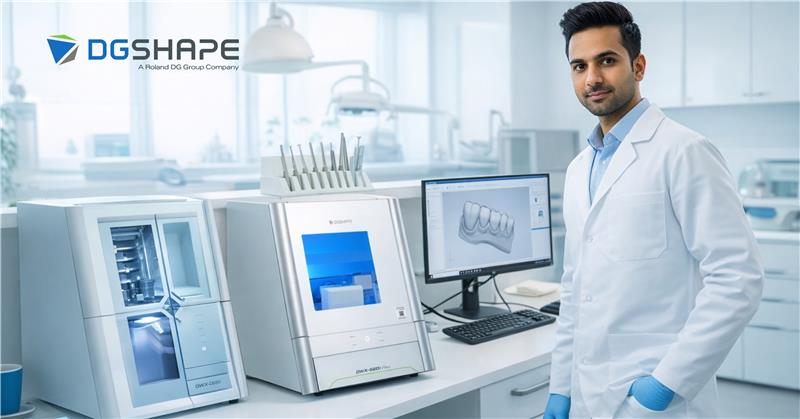
Today, the demand for restorative dentistry has increased in India, and eventually, the workload and pressure on the dental care providers, especially the dental care labs, are increasing equally. To handle this pressure strategically, modern care providers are adopting digital dentistry workflows, especially advanced equipment like digital scanners and dental milling machines.
A recent report by IMARC has found that in 2024, the Indian restorative dental care market reached USD 750.40 Million. By 2033, the same report projects that the restorative dental care market will reach USD 1,705.50 Million (127%↑) with a CAGR of 8.84%.
Also known as dental crown milling machines or dental CNC milling machines, these machines have different types, and picking a suitable type for your lab can be confusing. Therefore, this blog presents detailed information about different types of machines a modern lab may use according to its production size, material focus, and automation requirements. Discover the varying types and pick the right one for your business.
What is Dental Milling Machine?
Dental Milling Machines are CAD and CAM software-driven machines that automate the process of dental restoration crafting. Dental care professionals can craft restorations such as crowns, bridges, bite splints, veneers, etc. within hours in high-quality with machine-driven precision milling without compromising the quality.
Dental milling machines help dental care professionals produce high-quality and large quantity restorations in less time and effort. Today, dental mills have become a competitive edge for dental labs and clinics. When coupled with more digital solutions like digital appointment bookings and oral scans, the introduction of dental mills elevates the patient experience to the next level.
What is A Modern Dental Lab?
Before coming directly to the types of dental lab milling machines, it is important to understand how modern dental labs are different from traditional labs.
Modern dental labs are such labs that have upgraded their business style to digital workflows for high precision, faster restoration, and better patient care.
However, these digital workflows do not limit to only machine-driven workflows but also:
- Digital Oral Scanners/Intraoral Scanners
- Restoration Designing with CAD Software Solutions
- Machine-Driven Restoration Crafting
- Adoption of Electronic Health Record (EHR) Systems
- Digitalized Patient Journey from Booking to Check-out
Such digitalized workflows enhance the patient experience to the next level, leaving patients with higher satisfaction.
How Modern Labs Overcome Problems of Traditional Dental Labs
Comparatively, traditional labs, still sticking to the manual workflows, face various problems such as:
- Longer patient journeys from appointment booking to checkouts.
- Unnecessary overdependence upon paper records (subject to misplacement, loss, and physical damage)
- Weeks of the dental restoration development process
- Repetitive Marginal Misalignments and Remakes
- High material wastage
- Tiring auto-cleaning processes
But, modern labs are overcoming such problems with digitalization.
- Online Appointment Booking Modules reduce the patient journey timeline by 90%.
- Adoption of EHR systems eliminates paper-based health records. Cloud-based soft copies of patient history and prescriptions are a safer option, free from the fear of physical loss, damage, and misplacement.
- Shorter production cycles with fast digital workflows.
- Reduced remakes with perfect margins with dental CNC milling machines.
- Low material wastage with smart automation technology.
- Auto dust cleaning features are provided by a high-end dental milling machine.
Clearly, the role of dental mills is significantly impactful in digitalizing dental care workflows. Eventually, it may be worth concluding that dental mills have become the heart and soul of modern dental labs.
Dental Milling Machines: The Heart & Soul of Modern Dental Labs
Introduction of a dental CAD CAM milling machine with a digital scanner is the fastest way to digitalize the workflows. For a dental laboratory, handling bulk production, such as equipment, has become a necessity for handling workloads at speed without losing precision.
However, such machines come in different types. Identifying which is the best dental milling machine for your lab can seem challenging. The following information may help make the best decision:
Types of Dental Milling Machines
A milling machine has 3 major aspects – operational style, status of axes, and automation level. On the basis of these 3 major aspects, milling machines have 7 key types described as below with their use cases:
- Dental CAD CAM Milling Machine Types by Operational Styles
A dental crown milling machine may provide either wet or dry or both (hybrid) milling solutions. The milling type depends upon the requirements of a dental restoration and the applicable material type. These sub-categories include:
#1 Wet Dental Milling Machine
A wet dental milling machine comes with built-in coolant systems. The coolant system makes a wet dental mill perfect for handling glass ceramics milling material.
Furthermore, wet milling machines deliver dental restorations with high aesthetics, shiny surfaces, and a smoother finish. It makes these machines perfect for cosmetic dental care labs.
However, as wet milling machines can handle only a moderate workflow in a day, they are not suitable for large-scale labs handling bulk production. Cosmetic dental clinics can buy a wet milling machine for an upgrade.
#2 Dry Dental Milling Machine
For large-scale dental labs focusing on mass production, dry dental crown milling machines are the right option.
Compatible with milling materials such as zirconia, PMMA, wax, and composite resins, dry mills are built for high production, low maintenance, and durable restorations.
Some case studies show that certain dental mill models provide such high-end automation that a dental lab can use them for unmanned mission.
#3 Hybrid Dental Milling Machine
Some machine models combine dry and wet milling procedures. Such machines are called hybrid milling machines.
As the name suggests, hybrid machines can mill both types of materials – glass ceramics and composite resins. A hybrid model is like a 2-in-1 model.
However, it is advisable for large-scale production labs to invest separately in precision-focused dry and wet milling models. So that, if a breakdown occurs in one unit, the other unit saves the lab from unproductivity.
| Type | Best For | Materials | Production Scale |
| Wet | Aesthetic restorations | Glass ceramics | Moderate |
| Dry | Mass production | Zirconia, PMMA | High |
| Hybrid | Versatile lab operations (wet & dry) | Glass ceramics, Zirconia, PMMA | Moderate to High |
- Dental Milling Machine Types by No. of Axes
Depending upon the movements that the machine performs while crafting a restoration, there are 2 types of dental CNC milling machines.
#1 4-Axis Dental Milling Machine
When a dental mill has 4 types of movements, including:
- Left ↔ Right (X-Axis)
- Front ↔ Back (Y-Axis)
- Up ↔ Down (Z-Axis)
- Rotation of the Blank (A-Axis)
It comes under the category of a 4-axis dental milling machine. These machines are good for crafting crowns, inlays, onlays, veneers, and bridges.
#2 5-Axis Dental Milling Machine
However, for precision cuts and carvings, 5-axis machines are preferable as they come with the ‘tilt’ of the material block.
This provides deep undercuts and high precision to a dental restoration. Medium to large-scale dental labs prefer 5-axis machines.
- Dental CNC Milling Machine Types by Automation Level & Production Capacity
Finally, another core aspect to check while selecting a machine for your dental lab is the automation level. Remember, the higher the automation, the higher the dental lab milling machine price.
But, eventually, the higher the automation, the better the work-life balance. On the basis of automation level, a dental laboratory has two options:
#1 Dental Milling Machines with Moderate Automation
For dental labs with a steady workflow, moderate automation machines are suitable. Moderate automation machines come with features like:
- Automatic Tool Changer
- Auto-Dust Cleaning (dry milling)
- Remote monitoring (controlling excluded)
Moderate automation machines provide a streamlined workflow to the labs. However, such machines are not for an unmanned mission.
Currently in India, DGSHAPE, the renowned dental milling manufacturer, provides the 2 best dry Dental CAD CAM Milling Machine models with moderate automation.
These machine models include DWX-52Di Plus and DWX-52D Plus. Both models come with a 15-station Auto-Tool Changer and decent remote monitoring and dust cleaning features.
#2 Dental Milling Machines with High-End Automation
Dental labs operating on a large scale and extra shifts due to heavy workload, can leverage high-end automation milling machines that come with features like-
- Remote Monitoring & Performance Analytics
- Automatic Disc Changer
- Auto Tool Changer
- Low-Maintenance Features
- Auto-Dust Cleaning upto 90-95%
Such machines enable round-the-clock production with unmanned missions and are perfect for large-scale dental labs working in multiple shifts. In India, DGSHAPE offers DWX-53DC and DWX-52DCi Plus for high-end automation.
How to Choose the Best Dental Milling Machine for Dental Lab?
Decision to buy a dental CNC milling machine for your dental lab must not limit to the price, rather, it must be a practical decision based on a variety of key drivers, including operational needs, production goals, and future scalability.
Simply put, the following considerations are necessary while choosing a dental mill for your lab:
- Production Size You Usually Handle
A dental laboratory with a high production size, handling a massive number of restorations that require high precision, such as crowns, veneers, bridges, and implants require 5-axis solutions. Additionally, moderate automation models can work for them.
- Material Focus of Your Lab
Labs dealing in glass ceramics, sintered zirconia, and hybrid ceramics must opt for wet milling machines for smooth surface finishes.
On the contrary, labs dealing in materials like PMMA, PEEK, PEKK, Gypsum, composite resins, etc. must opt for dry milling machines.
- Your Expectations from the Machine
The expectations of the buyers from the machine also affect the decision. While purchasing a dental milling machine for your lab, ask yourself, to what extent do you want automation?
Your expectations from the machine’s production capacity, ability to function unmanned, remote monitoring facilities, and auto-cleaning features. Consult an experienced machine expert, and share your requirements with them to find the best solution for your lab.
- Scalability Business Goals
Labs planning to scale from medium to large-scale production or from crafting simple restorations to complex ones must invest in 5-axis dental milling machines with high-end automation.
Otherwise, investing in a moderate machine and then facing troubles during the scaling phase will cost more than the cost of a high-end machine.
Final Notes
As the demand for restorative dental care is rising consistently in India, the adoption of digital workflows has become a necessity for dental labs facing heavy workloads. Digitalizing the restoration process through dental milling machines and software solutions like CAD, CAM, EHR, Appointment Booking Modules, etc., not only enhances the patient care experience with a shorter and more comfortable patient journey, but also enables a lab to seamlessly handle the mass production.
However, choosing the right Dental CAD CAM Milling Machine model makes a significant impact on the buyer. Choosing wisely, keeping in mind the production level, automation expectations, scalability goals, and milling material types a lab usually handles, are the key determiners. So, strategise wisely and select strategically.
Frequently Asked Questions
- Which is the Best Dental Milling Machine in India?
Currently, DGSHAPE is the top-notch brand in India for dental milling machines. Headquartered in Japan, DGSHAPE is a Roland DG Group Company, renowned globally for its high-end dental milling machine design and precision manufacturing. It offers a variety of dry and wet milling machine models for dental labs and clinics.
- Which Dental Milling Machine is Best for Large-Scale Dental Labs?
Large-scale dental labs handle heavy production cycles and operate on multiple shifts. DGSHAPE offers 5-axis dry dental milling machine models like DWX-53D, DWX-53DC, and DWX-52DCi Plus. All these models offer moderate to high-end automation with fast spindle speed and automatic dust removal features. For labs working on multiple shifts, these models can provide faster production in high-quality, saving time, cost, and effort.
- What is the Difference Between 4-Axis and 5-Axis Dental Milling Machines?
A 4-axis dental milling machine provides 4-directional movements across the X-axis (left ↔ right), Y-axis (front ↔ back), Z-axis (up ↔ down), and A-axis (which is the rotation of the blank). The 5-axis dental milling machines come with an extra movement, which is the tilting of the material block for deep undercuts and precision carving.
- Is Wet or Dry Milling Better?
Both wet and dry milling procedures have their own applications, and they are not comparable. For a smoother surface finish with high aesthetics, wet milling is preferable. Usually, cosmetic dental restorations require wet milling.
Cosmetic restorations use gloss-finish materials such as glass ceramics that require extreme care during the milling procedure. Wet milling uses coolant to protect such materials from heat damage.
On the contrary, for dental restorations that require materials that produce fine dust during the milling process, in place of chips, such as Zirconia, PMMA, etc. Dry milling is the best option. Both wet and dry milling procedures deliver high-quality and durable restorations.
- How Much Does A Dental Milling Machine Cost in India?
Dental milling machine cost in India depends upon various factors. Especially, the machine model type and its features define the price. While 4-axis milling machines with low-automation features can be a budget-fit, 5-axis mills with high-end automation can cost more. There is no fixed cost as such.


