

Digitalization is at its peak all around the world. India is among the fastest technologically growing countries. From education to entertainment, healthcare, real estate, finance, and whatnot? Digitalization is observed in every field. Digitalization in the medical and dental industries is also taking over Indian medical businesses these days. The introduction of dental milling machines in India is rapidly changing how modern-age dentists work.
In this blog, we shall discover what dental milling machines are and how they are digitalizing the Indian dentistry. After reading this blog, dental professionals will discover how a general investment in a good dental CAD/CAM milling machine can help improve the workflows.
What Are Dental Milling Machines and How Do They Help?
If you are new to the term ‘dental milling machine’, then here is an explanation – A dental milling machine is a software-driven device that comes with built-in (embedded) or installable CAD/CAM software for digitalizing the oral scan and restoration design, and automates the manufacturing of dental restorations.
In very simple words, a dental milling machine automates the entire dental restoration crafting process through CAD/CAM technologies. Dental CAD/CAM milling machines encourage digital dentistry and enhance the speed, accuracy, and aesthetics of the dental restorations.
How Dental Milling Machines Help?
- High Precision: Software-driven machines, unlike humans, do not err. The precision of the dental restorations is much higher. Thus, you deliver better quality restorations.
- High Accuracy: Machines do not get tired, they do not bring variation, as they lack creativity. Therefore, once programmed, a CAD/CAM milling machine delivers the same quality of restoration every time with 100% accuracy. No reworks!
- Superfast Restoration: However, the traditional dental restoration creation process is quite time-consuming. It takes around a week to deliver a restoration with traditional methods. But in the case of a dental milling machine, it hardly takes 1 day or 2.
- High Patient Satisfaction: Introducing dental milling machines helps you reduce the chairside time. Additionally, they deliver restorations with precision. Eventually, the patient satisfaction increases.
- Of Course, Better Revenues: When there is so much to deliver to the patient in the least time, clearly, you open the doors for higher revenues.
The Status of Digital Dentistry in India
India is among the fastest technology-adopting countries worldwide. Every business industry in India has welcomed digitalization with open arms, and so has dentistry.
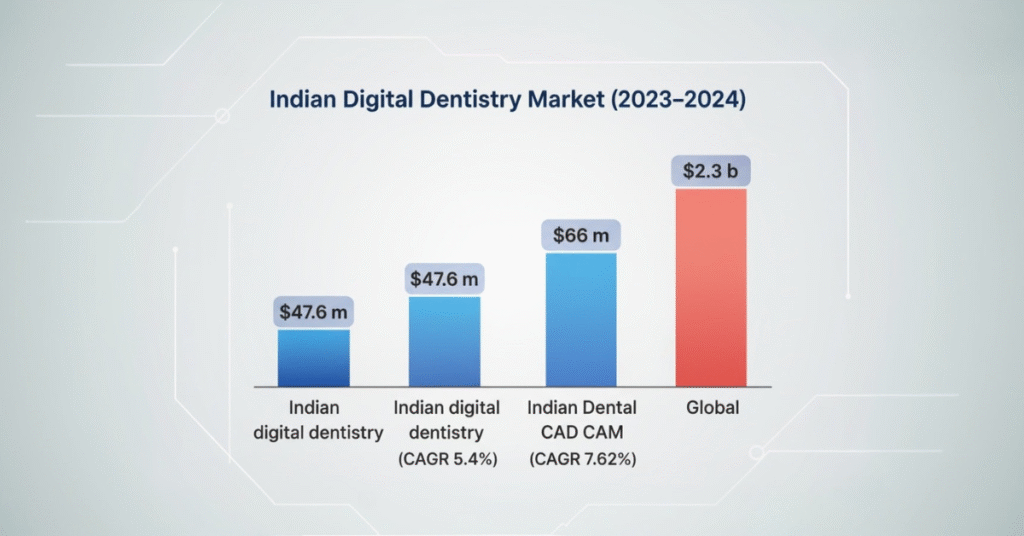
According to a report by iData Research, a renowned healthcare market research consulting firm, in 2023, the Indian digital dentistry market was valued at $47.6 million. The same organization also estimated that the Indian digital dentistry market will grow at a CAGR of 5.4%.
Furthermore, according to a report by Market Research Future (MRFR), another market research company estimated the Indian Dental CAD CAM market to reach $66 million in 2024. MRFR estimated the CAGR even higher than iData’s estimation at 7.62%.
Comparatively, the global market appears much larger, with a market valuation of $2.3 billion in 2024, according to a report by IMARC Group, an American market research and consulting firm.
However, the estimated Indian digital dentistry market share is hardly 2.07% (approx.), yet the growth is rapid and noteworthy.
Problems That Indian Dentists Face in the Absence of A Dental Milling Machine
Encouraging digitalization in the dentistry industry in India can change the way Indians leverage dentistry facilities forever. Adoption of dental milling machines can be a great move for the Indian dental businesses for faster and better dental treatments.
The absence of dental milling machines in India deprives dentists and patients of timely and accurate dental care practices. Additionally, the traditional and manual dental restoration process poses multifaceted problems for dentists, patients, and, surprisingly, also the environment. Here is an overview:
Too Long Process
Crafting dental restorations with manual processes is time-consuming process. It takes around a week or two, and accuracy is never a promise. The manual process starts from taking the patient’s teeth impression in molds made of alginate or silicone. Followed by further steps, including-
- Making a Plaster Model
- Creating the Wax model
- Molding the restoration material according to the wax model
- Waiting for metal hardening
- Then, melting the Wax model
- Finishing and polishing the final piece of restoration
- Fitting the restoration in the patient’s mouth.
When all these steps are performed manually without any automation technique, they consume a lot of time.
Patient’s Discomfort
In addition to being time-consuming, the traditional dental restoration creation methods are also uncomfortable for the patient. These methods have high chairside time, making the sick patients sit in unwanted positions for a long time.
Furthermore, these alginate and silicone molds are not only messy but also choky sometimes. Also, manually, the level of fixture accuracy may or may not be accurate, as to err is human. If not accurate, these fixtures may introduce further pain and discomfort for the patient.
Increased Chances of Human Errors
As stated above, to err is human! Maybe due to fatigue or lack of skill and experience, a human may not be able to craft an accurate size and design.
Therefore, humans might commit errors leading to rework. Say, for example, incorrect molding, selection of the wrong material, unaesthetic finishing, and many more. This can further increase the time and discomfort of the patient.
Inconsistency in Designs
Humans are in different moods, and their mental state varies according to their emotional state.
And emotional state, in turn, is affected by their day-to-day life events. It is a universal fact that the mental health, mood, and emotional state of people directly affect their work efficiency.
As a result, the performance may vary with the mood. Eventually, the designs may be inconsistent, leading to undetermined restoration and fixture quality.
Average Finish
Depending upon skills, expertise, and experience, the finish of the restoration that a human delivers may or may not be up to the mark. Dental restoration creation is not only a science, but a blend of science, craftsmanship, and art.
According to a renowned Psychologist, Howard Gardner, humans have 8 types of intelligence combining linguistic, logical-mathematical, spatial, musical, bodily-kinesthetic, interpersonal, intrapersonal, and naturalist.
Hardly any human can have all 8 types of intelligence abundantly. Eventually, if a human is crafting the dental restoration, it may or may not have a perfect combination of size accuracy and aesthetic finish.
More Medical Waste
Did you know that the traditional dental restoration creation process adds to huge medical waste worldwide? The traditional casting, grinding, and impression collection methods generate environmentally hazardous waste, which lacks biodegradability. Here’s an overview:
- Impression collection materials like alginate, silicone, or polyether are synthetic polymers that are non-biodegradable. Once done their job, they end up in landfills.
- Casting materials like Gypsum and Plaster contain calcium sulphate hemihydrate, which releases polluting sulphur compounds during its breakdown. While Gypsum often adds to the volume of landfills, occasionally it contaminates groundwater when dumped in waterbodies.
- Metal casting alloys like nickel-chromium, cobalt-chromium, and palladium are a major source of air pollution as they release metal fumes and particulates during the melting process. They are also toxic to the soil.
- Furthermore, the acrylic resins (such as PMMA), glass ceramics, and the polishing and finishing residues are hazardous to health if inhaled. This leads to respiratory problems for the craftsman.
Eventually, the manual dental milling process is problematic not only for the dentists but also for the patients and the environment as well.
It challenges environmental sustainability, stakes patients’ comfort, and troubles the craftsman (or dentists) physically and mentally.
How Dental Milling Machines Help Dentists Work Faster & Better?
Also known as a Dental CNC Milling Machine, Dental milling machines have unlimited benefits for the dentistry industry.
The most anecdotal benefit of these machines is that they eliminate the above-listed problems to a great extent. Here is how dental milling machines help:
Faster Restorations
Adoption of a dental milling machine dramatically reduces the chairside and overall dental restoration time by 70-85%. Unlike the 1-2 week-long traditional process, a dental milling machine can craft better quality and more accurate fixtures in 1-2 days.
Eventually, dental CNC milling machines not only add to the patient’s comfort level but also boost the work efficiency and productivity for the dental laboratory or clinic.
Certain machines, like DGSHAPE dental milling machines, offer 360-degree automation with remote monitoring. This further ensures higher productivity and comfort in the dental labs and clinics.
No Messy and Choky Molds
Dental milling machines use digital oral scanners, eliminating messy and choky molds made of environmentally hazardous material.
With Computer-Aided Design (CAD) software integration, patients only need to give a quick digital scan of their mouth. No impression needed on an uncomfortable alginate, silicone, or polyether mold.
CAD/CAM Driven Workflows, No Human Errors
A Dental CAD/CAM Milling Machine automates the entire dental restoration creation process from impression gathering to finishing the fixture. The CAD/CAM software is pre-programmed and works as the brain of the milling machine.
Based on the digital scan, the CAD/CAM software delivers consistent instructions to the machine, and the machine crafts a well-thought-out fixture each time. No human errors, only perfection and consistency.
Design Consistency
Due to the pre-programmed CAD/CAM software integration, the machine uses the exact same method and does not show variations in the product quality.
Eventually, the dental milling machines deliver consistent designs. If a dental laboratory or clinic chooses the right dental milling machine manufacturers, it gets the best quality dental restorations every time.
Consistently delivering high-quality products naturally boosts in-store traffic and revenues of the dentistry business.
Aesthetic Finish
Dental milling machines are also designed to deliver an aesthetic finish to every dental restoration they craft. The Indian upper-middle-income, high-income, and public figure groups are noticing a rising craze for smile beautification.
Eventually, shining and picture-perfect teeth are the aspiration of many. As already discussed, humans may or may not have mastery over artistic and scientific skills simultaneously.
Having the required craftsmanship to deliver an aesthetic smile may or may not be in the hands of humans. But, machines once programmed can deliver highly aesthetic fixtures.
They maintain the right mix between the polishing time and material quantity, and hence deliver top-quality shine. A dental milling machine ensures that every restoration appears natural, yet better.
Up to 90% Waste Reduction & Auto-Cleaning
To everyone’s surprise, dental milling machines reduce the waste up to 90%. By eliminating silicone, alginate, and polyether molds and mixing cups and trays, dental milling machines reduce hazardous landfill waste.
Additionally, dental milling machines focus on high precision milling, ensuring minimal material wastage. This further reduces the waste production caused by milling materials like composite resins and more.
Moreover, the leading dental milling machines in India, such as DGSHAPE machines, come with an auto-cleaning system, removing the leftovers and debris on their own, saving dentists and lab technicians from unwanted jobs.
No Inhalation, No Health Hazards for the Craftsman
The best dental milling machines in India, like DGSHAPE, also provide certain models with an auto-cleaning feature, remote monitoring, and 360-degree automation.
Eventually, the craftsman, be a dentist or a lab technician, does not need to inhale the hazardous materials all day long while crafting the restoration. This saves them from various respiratory diseases.
So, Invest in A Good Dental Milling Machine Today!
Based on the above discussion, it is concludable that the introduction of a dental milling machine in any dental clinic, hospital, or laboratory can revolutionize Indian dentistry to a great extent.
From reducing the process time to enhancing the precision and accuracy of the fixture, and boosting the overall productivity, efficiency, and revenues of the business, dental milling machines can do wonders.
The dental milling machines have multifaceted benefits for dentists, patients, and also for the environment. Therefore, every Indian dental lab, clinic, hospital, and dental college as well must have a reliable dental milling machine.
So, invest in a reliable dental milling machine today and take a step forward to advanced and future-ready dentistry.