
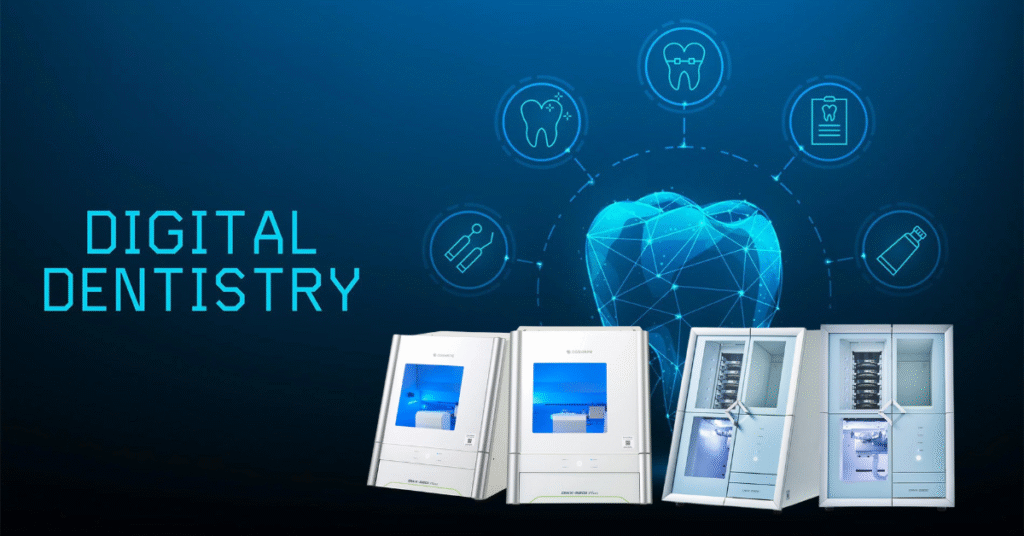
Digitalization is penetrating every business Industry at a noticeable pace and changing the ways people work and live. The dental care industry is an integral part of healthcare, undergoing digitalization with CAD/CAM dental milling machines.
People worldwide have now become more aware of dental care. They associate good oral health directly with their self-esteem and confidence. Eventually, the workload of the dental care industry is gradually increasing, and dental clinics, labs, and institutes now need to speed up the process.
However, to deal with this workload with precision, accuracy, and speed has become a challenge for the dental care professionals. To combat this challenge, embracing digital dentistry practices is a promising solution. In this blog, we will discover what digital dentistry is and how it is helping the dental care businesses to elevate their workflows.
What is Meant By Digital Dentistry?
Digital Dentistry is the practice of using digital tools such as CAD software, CAM systems, and AI-driven automation systems for faster, more accurate, and better quality dental treatment and care. In simple terms, digitalization in dental care for improved patient outcomes is called digital dentistry.
Core Elements of Digital Dentistry Solutions
Digital dentistry is made up of various elements. The core elements of digital dentistry solutions include the following 5 practices:
Digital Imaging with Intraoral Scanners
Taking dental impressions with impression materials like silicone, alginate, dental plaster, etc., is a time-consuming and discomforting process. Therefore, these days, digital imaging in dentistry with intraoral scanners has become a trend.
CBCT (Cone Beam Computed Tomography) is another pivotal part of 3D imaging systems that can capture the complete jaw anatomy with bone density check and nerve pathways.
Digital scans eliminate the choking and time-consuming dental impression process, making dental care more comfortable for the ailing patient.
Digital Design with CAD Software
Computer-Aided Design Software is another key area of digital dentistry. While designing dental restorations, high precision is the top priority for the dental professional.
CAD software ensures high accuracy in design. For smile designs, CAD software plays a pivotal role. Additionally, it is also helpful in
- Designing crowns and bridges
- Creating veneers
- Designing inlays/onlays
- Planning implant abutments and frameworks
- Customizing prosthetics
When the design process is backed by digital tools, accuracy increases by 10x.
Milling with CAM Systems
Computer-Aided Manufacturing (CAM) systems are the next step in digital dentistry. At this point, the role of a Dental Milling Machine comes to the limelight. Dental milling machines utilise CAM systems to fabricate dental restorations.
This way, the entire dental milling process automates. The digital tools ensure accurate measurements and fit the restoration design. Eventually, a CAD/CAM milling machine reduces the number of reworks.
3D Printing Technology
The 3D printing is also a part of dental milling machines. The dental milling machines have built-in 3D printers that craft a dental restoration layer by layer.
Suitable for provisional restorations like surgical implant guides, aligners, retainers, models, and trays, 3D printing increases the speed and accuracy of dental milling procedures.
AI and ML In Digital Workflows
These technologies listed above are often backed by Artificial Intelligence (AI) and Machine Learning (ML) technologies. AI and ML use large datasets and identify patterns, assisting dentists in diagnosis, outcome prediction, and overall treatment planning. These 5 pillars of digital dentistry make the workflow 5x smoother and elevate the quality of patient care by 10x.
The Rising Trend of Adopting Digital Dentistry & Dental Milling Machines Worldwide
The adoption rate of digital dentistry is evidently increasing at a rapid pace. If we look at the statistical data worldwide, it proves that dental professionals are shifting towards digital workflow quite consistently. Let’s have a look at the following eye-opening data-
- As per a report by Grand View Research, the global digital dentistry market values USD 6.8 billion in 2024.
- According to a report by Fortune Business Insight, the market of intraoral scanners was valued at USD 582.1 million in 2024. The same report predicted that the market will hit USD 1.23 billion by 2032, demonstrating a CAGR of 9.7%.
- Additionally, another report by Grand View Research suggests that the market of dental milling machines values at USD 1.96–2.16 billion worldwide for the year 2023-24.
- The same report above proclaims that the market of dental milling machines will grow at a CAGR of 9%.
- Considering India specifically, research from iData valued the Indian digital dentistry market at USD 47.6 million in 2023.
Clearly, the growth is evidently exceptional, and the expected growth is even more impressive. The stat concludes that dental care professionals across the world are taking digital dentistry very seriously and embracing it wholeheartedly.
DGSHAPE Dental India itself has various instances where dental care professionals have accepted improvement in patient care, satisfaction, and their own work-life balance with DGHSHAPE dental milling machines. The case of Dental Lab Academy by Dahmen & Asma is one of such instances.
The co-founders of Dental Lab Academy by Dahmen & Asma have admitted experiencing natural aesthetics, perfect fit, and long‑lasting results with DGSHAPE dental milling machines.
Apart from this, there are many more success stories like these, indicating that digital dentistry is contributing towards better patient care and the work-life balance of dentists.
Why the Dental Care Industry is Shifting Towards Digital Dentistry?
The varying benefits of digital dentistry have shifted the dental professionals towards investing in dental milling machines. To discuss briefly, the following 3 core reasons make dentists adopt digital dentistry wholeheartedly:
- Increased Patient Satisfaction: As digital workflows ensure higher accuracy, precision, and finish, the outcomes increase patient satisfaction to a great extent. Additionally, reduction in the chairside milling time.
- Reduced Reworks: When the accuracy and precision are high with digital scans and CAD/CAM-based dental milling procedures, the number of reworks goes down. This eventually leads to better customer experience and higher productivity, helping dental care businesses boost their revenues.
- Better Work-Life Balance of Professionals: The advanced model CAD/CAM dental milling machines often come with remote monitoring and smart, independent dental milling features. Say, for example, DWX-52DCi Plus and DWX-53DC models by DGSHAPE. This way, dental care professionals achieve a better work-life balance. Michal Plocica is one of such examples who found a better work-life balance with the DGSHAPE dental milling machine and its remote monitoring function.
Scope of Digital Dentistry in India: Should I Really Shift Towards Digitalization As a Dental Care Professional?
The data and stats discussed above clearly indicate that digitalization is becoming a crucial part of the dental care industry at a consistent pace. Scope of digital dentistry in India is undeniably substantial. Consider the following factors:
- Growing Awareness Among Educated Middle Class: Additionally, the social media and influencer culture have also created a demand among the educated middle class to own a beautiful smile. This has increased the workload of the dental care professionals. So, speeding up the milling and reducing the reworks simultaneously are a necessity for the dental clinics and labs.
- Focus of the Indian Government on Digitalization: The Indian government is focusing hard on digitalization across all walks of life. Especially, in the medical and healthcare industry. Through Ayushman Bharat Digital Mission (ABDM), the Indian government has created over 61.6 million ABHA health IDs and linked 38.13 million health records, emphasizing the adoption of telemedicine and digitalization in healthcare. Eventually, dental labs and clinics also need to match the pace to avoid lagging behind.
- Digitalization in Education: Just like the medical industry, the education industry in India is also transforming towards EdTech. Digital India mission is a pivotal move by the Indian government that emphasizes the implementation and adoption of eLearning and online education. Education system is the foundation of society. When the entire society is moving towards digitalization, every business industry needs to adapt.
So, the answer to whether it is necessary to embrace digital dentistry in India is yes! Choosing digital dentistry can not only elevate the quality of patient care but can also bring higher revenues to the dental care business. So, digital dentistry is undeniably the future.
Parting Thoughts
Digital dentistry is the emerging future of the dental care industry. CAD/CAM dental milling machines are crucial for digitalization in the dental care industry. Ensuring higher accuracy, faster milling process, and premium-grade automation, dental milling machines improve the quality of patient care, while also helping the dental care professionals to enhance their productivity without compromising their work-life balance.
The Indian government taking initiatives like Digital India and Ayushman Bharat Digital Mission also indicate that digitalization in the medical industry is the national priority. So, start digitalizing your dental clinic, lab, and also training institute today with reliable intraoral scanners and right CAD/CAM dental milling machines.
Is Digital Dentistry a Profitable Move for Small or Mid-Sized Clinics in India?
Yes, small and mid-sized dental clinics must also invest in a good CAD/CM milling machine. With a reliable machine, the small clinics can improve the quality of restorations and be independent of expensive dental laboratories.
This can save the clinics from paying high commissions to the dental labs and ensure direct restorations to the patients. It will improve the revenues for the clinics.
How Accurate is Digital Milling vs Manual Lab Work?
Manual lab work depends upon humans. It is a well-known fact that no individual is in the same mental state every day. Humans may err, but machines do not.
A dental milling machine ensures consistent quality in every dental restoration. Therefore, CAD/CAM-based dental restoration is more accurate as compared to manual lab work.
Are There Any Drawbacks of Digital Dentistry?
The drawbacks associated with digital dentistry are not very serious and can be overcome easily. To list the handful of drawbacks of digital dentistry, we can consider attitudinal barriers among adopters, a non-tech-savvy audience, and occasional machinery downtime are a few examples. However, if the advantages are compared against the drawbacks, they win.
How Much Time Does CAD/CAM Save in Crown/Bridge Production?
Great CAD/CAM dental milling machines ensure same-day restoration. However, considering the workload, it might take 2 days to deliver a finished crown or bridge. On the contrary, manual procedures take a minimum of a week or even more than that. Thus, dental milling machines save a considerable time in crown and bridge production.
Is Digital Dentistry Reliable For Single-Day Dentistry?
In a word, yes! In fact, digital dentistry is the only key to single-day dentistry. A dental milling machine can finish almost every type of dental restoration within a day. Eventually, increasing the speed without compromising the accuracy of a dental restoration.
Can Digital Dentistry Reduce Reworks?
Definitely. Smart CAD/CAM-based dental milling process enhances the quality and accuracy of the restoration and brings consistency in design. When dental restorations are satisfactory and comfortable for the patient, no rework is required.
As a Dentist, Will I Need a Well-Trained Technician to Operate a CAD/CAM Milling Machine?
Not at all. As you install a dental milling machine in your dental clinic, a professional visits for the installation and offers a detailed demo. The user interface of the CAD/CAM dental milling machines is often designed for non-trained technicians for easy operation. Therefore, a dentist will not need a technician and will operate the machine independently post-installation.
Which is Better – Dry Dental Milling or Wet Dental Milling Machine?
It totally depends on your clinical workflows. If your workflows revolve more around cosmetic dentistry, then a wet dental milling machine will be a better option for a shiny finish and aesthetic designs. However, if your workflows require high-volume production, then go with the dry dental milling machines. If suitable, a clinic may invest in both dry and wet dental milling machines and serve all types of patient requirements.